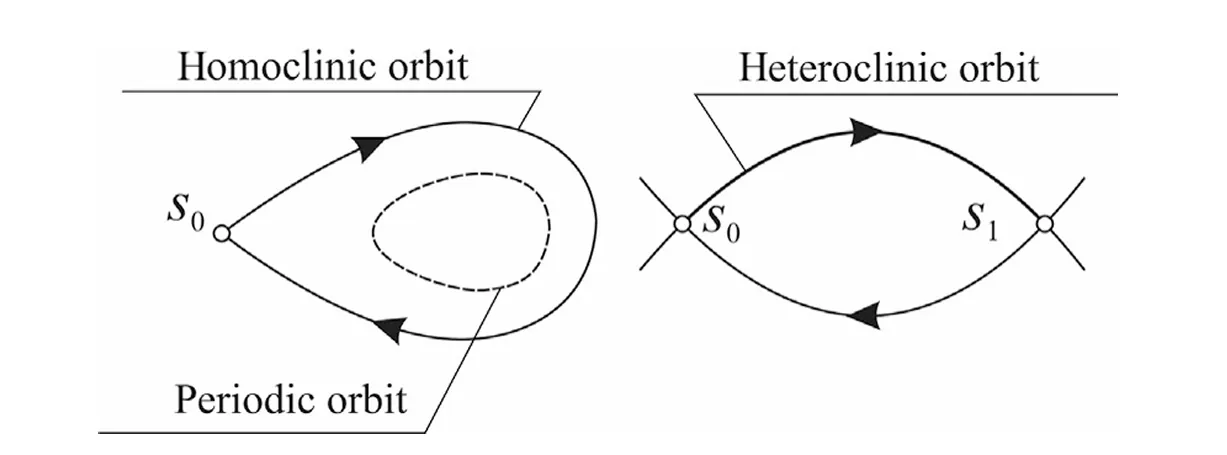
For homo case, a homoclinic orbits lies in the intersection of the stable manifold and the unstable manifold of an equilibrium. (A homoclinic orbit is a path through phase space which joins a saddle equilibrium points to itself.)
P-B theorem and $\omega$-limit set: The $\omega$-limit set of a planar dynamical system is classified by Poincaré-Bendixson theorem when it is compact, namely into three categories--
- an equilibrium point;
- a closed orbit and
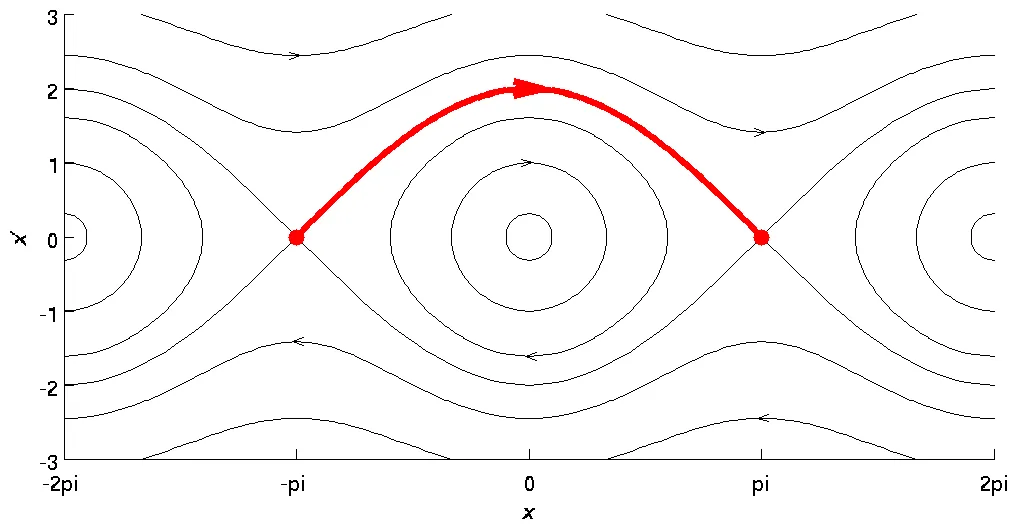
- finitely many equilibrium points with homoclinic and heteroclinic orbits between them.
- a fixed point
- a periodic orbit or
- a connected set composed of a finite number of fixed point together with homoclinic and heteroclinic orbits connecting them.
Continuous dynamical systems that are defined on two-dimensional manifolds other than the plane (or cylinder or two-sphere), as well as those defined on higher-dimensional manifolds, many exhibit $\omega$-limit sets that defy the three possible cases under the Poincaré-Bendixson theorem. On a torus, for example, it is possible to have a recurrent non-periodic orbit, and three-dimensional systems may have strange attractors. Nevertheless, it is possible to classify the minimal sets of continuous dynamical systems on any two-dimensional compact and connected manifold due to a generalization of Arthur J. Schwartz.
Moreover, there is at most one orbit connecting different fixed points in the same direction. However, there could be countably many homoclinic orbits connecting one fixed point. One important implication is that a two-dimensional continuous dynamical system cannot give rise to a strange attractor.
P-B 定理意味着混沌现象不会在相平面发生.
P-B 定理主要依赖于平面的二维性, 在高维 ($n\ges3$) 系统中, P-B 定理不再适用, 会产生一些新的现象, 即轨迹可能永远在一个有界区域内, 不会停滞在一个不动点或一条闭轨上. 在某些情况下, 轨迹被一个称为奇怪吸引子的复杂几何图形所吸引——在一个分形集上, 运动是非周期的, 对初始条件具有敏感依赖性. 这种敏感依赖性使得长期性的运动是不可预测的. 这就是我们所讨论的混沌现象.