目录
目录
1. 笔记
2. 复形范畴
2.1. 加法范畴上的复形范畴
2.2. Abel 范畴上的复形范畴
2.3. 上同调函子
2.4. 上同调函子的性质
2.5. 拟同构
3. 同调代数基本定理
4. 同伦范畴
4.1. 同伦
4.2. 同伦范畴
4.3. 关键公式
5. 投射分解和内射分解
5.1. 马蹄引理
6. 导出函子
6.1. Motivations
6.2. Construction and first properties
6.3. Variations
7. $\mr{Ext}^n$ 函子
7.1. 背景
7.2. 正文
7.2.1. 左正合反变函子
7.2.2. 左正合共变函子
7.2.3. 足够多的投射、内射对象
8. $\mr{Tor}_n$ 函子
9. 同调维数
10. 拉回和推出
加法范畴可以讨论态射的加法、对象的余积; Abel 范畴可以讨论态射的核与余核, 进而可以讨论正合列.
整理:同伦、同构、拟同构、同伦等价
$\mr{Hom}$ 函子是左正合的
- $\mr{Hom}_\ca(-,N)$ 是反变函子
- $\mr{Hom}_\ca(M,-)$ 是共变函子
\begin{align*} I\ \text{是内射对象}\ &\Leftrightarrow\ \mr{Hom}_\ca(-,I)\ \text{正合}\ \Leftrightarrow\ \Ext^1_\ca(M,I)=0,\ff M\in\mr{Ob}(\ca)\\ P\ \text{是投射对象}\ &\Leftrightarrow\ \mr{Hom}_\ca(P,-)\ \text{正合}\ \Leftrightarrow\ \Ext^1_\ca(P,N)=0,\ff N\in\mr{Ob}(\ca) \end{align*}
$\ot$ 函子是右正合共变函子
- $M\ot_R-$ 是共变函子
- $-\ot_RM$ 是共变函子
有一类特殊的模, 用它作张量积后短正合列仍为短正合列, 正如投射模和内射模在 $\mr{Hom}$ 中所起的作用一样, 这种模就是平坦模.
$$M\ \text{是平坦模}\ \Leftrightarrow\ M\ot_R-\ \text{正合}\ \Leftrightarrow\ \mr{Tor}_1^R (M,N)=0,\ff N\in R-\mr{mod}$$
- 将 $X^n$ 称为 $X^\bullet$ 的第 $n$ 次分支.
- 将 $d^n: X^n\to X^{n+1}$ 称为 $X^\bullet$ 的第 $n$ 次微分.
- 只有一个非零分支的复形称为轴复形.
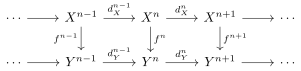
也将 $f^\bullet$ 简记为 $f$. 两个链映射相等是指 $f^n=g^n,\ \ff n\in\mbz$.
- 有界的: 如果只有有限个非零分支.
- 上有界/右有界:如果 $n$ 充分大时 $X^n=0$.
- 下有界/左有界:如果 $n$ 充分小时 $X^n=0$.
2.2. Abel 范畴上的复形范畴 设 $\ca$ 是 Abel 范畴, $f:X\to Y$ 是 $\ca$ 上复形的链映射. 对每个 $n$,
- 用 $\sigma^n: \operatorname{Ker} f^n \hookrightarrow X^n$ 表示 $f^n: X^n \rightarrow Y^n$ 在 $\mathcal{A}$ 中的核.
- 用 $\pi^{n+1}: Y^{n+1} \twoheadrightarrow \operatorname{Coker} f^{n+1}$ 表示 $f^{n+1}: X^{n+1} \rightarrow Y^{n+1}$ 在 $\mathcal{A}$ 中的余核.
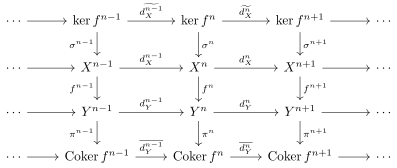
2.3. 上同调函子 设 $\mathcal{A}$ 为 Abel 范畴. 对于 $\mathcal{A}$ 上的上链复形 $X=$ $\left(X^n, d^n\right)_{n \in \mathbb{Z}}$ 和任一 $n \in \mathbb{Z}$, 因为 $d^n d^{n-1}=0, \forall n \in \mathbb{Z}$, 故有典范单态射 $\operatorname{Im} d^{n-1} \hookrightarrow \operatorname{Ker} d^n$ ,按照我们的记号,其余核记为 $\operatorname{Ker} d^n / \operatorname{Im} d^{n-1}$ . . 定义复形 $X$ 的 $n$ 次上同调对象为 $$ \mathrm{H}^n(X):=\operatorname{Ker} d^n / \operatorname{Im} d^{n-1} $$ 类似地, 对于 $\mathcal{A}$ 上的链复形 $X=\left(X_n, d_n\right)_{n \in \mathbb{Z}}$ 和任一 $n \in \mathbb{Z}$, 定义其 $n$ 次同调对象为 $$ \mathrm{H}_n(X):=\operatorname{Ker} d_{n-1} / \operatorname{Im} d_n \text {. } $$ 同理, $\mathrm{H}^n$ 和 $\mathrm{H}_n$ 仅仅是记号上的不同. 以后只对 $\mathrm{H}^n$ 叙述.
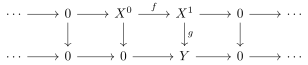
且 $g^{\bullet}$ 是拟同构, 但 $g^{\bullet}$ 不是 $C(R-\mathrm{Mod})$ 中的同构.
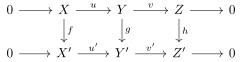
其中上下两行均为 $\mathcal{A}$ 上复形的短正合列, 则有 $\mathcal{A}$ 中长正合列的交换图

- 当 $X, Y, Z$ 三者中有两个为无环复形时, 第三个也为无环复形.
- 链映射 $u$ 是拟同构当且仅当 $Z$ 是无环复形; $v$ 是拟同构当且仅当 $X$ 是无环复形; 所有的连接态射均为同构当且仅当 $Y$ 是无环复形.
4. 同伦范畴 4.1. 同伦 首先我们介绍链映射之间的同伦关系.
- 设 $f: X \longrightarrow Y$ 是 $\mathcal{A}$ 上复形的链映射. 称 $f$ 是零伦的,如果存在 $\mathcal{A}$ 中一组态射 $s^n: X^n \longrightarrow Y^{n-1}, \forall n \in \mathbb{Z}$, 使得 $f^n=d_Y^{n-1} s^n+s^{n+1} d_X^n, \forall n \in \mathbb{Z}$. 图示如下:
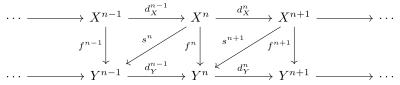
此时称 $s=\left(s^n\right)_{n \in \mathbb{Z}}$ 是链映射 $f$ 到链映射 $0$ 的一个同伦, 记为 $f \stackrel{s}{\sim} 0$, 或 $s: f \sim 0$.
- 设 $f: X \longrightarrow Y$ 和 $g: X \longrightarrow Y$ 是链映射. 称 $f$ 与 $g$ 同伦, 记为 $f \sim g$,如果存在 $f-g \stackrel{s}{\sim} 0$, 即 $f^n-g^n=d_Y^{n-1} s^n+s^{n+1} d_X^n, \forall n \in \mathbb{Z}$. 此时也记为 $f \stackrel{s}{\sim} g$,并称 $s=\left(s^n\right)_{n \in \mathbb{Z}}$ 是链映射 $f$ 到链映射 $g$ 的一个同伦.
- 同伦 $s$ 未必与微分可换, 即 $d_Y^{n-1} s^n \neq s^{n+1} d_X^n$.
- 同伦的链映射未必是相同的链映射.
- 链映射的同伦关系 $\sim$ 是范畴 $C(\mathcal{A})$ 中的等价关系.
证明
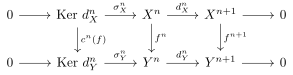
由如下交换图
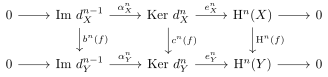
及单-满-分解 $d_Y^{n-1}=\sigma_Y^n a_Y^n \widetilde{d_Y^{n-1}}: Y^{n-1} \longrightarrow Y^n$ 得到
\begin{align*}
\sigma_Y^n c^n(f-g) & =\left(f^n-g^n\right) \sigma_X^n=\left(d_Y^{n-1} s^n+s^{n+1} d_X^n\right) \sigma_X^n \\
& =d_Y^{n-1} s^n \sigma_X^n=\sigma_Y^n a_Y^n \widetilde{d_Y^{n-1}} s^n \sigma_X^n .
\end{align*}故 $c^n(f-g)=a_Y^n \widetilde{d_Y^{n-1}} s^n \sigma_X^n$. 于是$$\left(\mathrm{H}^n(f)-\mathrm{H}^n(g)\right) e_X^n=\mathrm{H}^n(f-g) e_X^n=e_Y^n c^n(f-g)=e_Y^n a_Y^n \widetilde{d_Y^{n-1}} s^n \sigma_X^n=0$$从而 $\mathrm{H}^n(f)-\mathrm{H}^n(g)=0$.
4.2. 同伦范畴 设 $\ca$ 为加法范畴, $X$ 和 $Y$ 是 $C(\ca)$ 中的复形. 令 $$ \operatorname{Htp}(X, Y):=\{f \mid f: X \longrightarrow Y \text { 为链映射, 且 } f \sim 0\} . $$ 则 $\operatorname{Htp}(X, Y)$ 是 $\operatorname{Hom}_{C(\mathcal{A})}(X, Y)$ 的子群.
- 两个链映射在 $K(\ca)$ 中相等当仅当这两个链映射是同伦的.
- 零态射为零伦的链映射.
- 零对象为满足 $\mr{Id}_X\sim0$ 的复形 $X$.
- 不难验证, 两个复形在复形范畴中的余积(即通常复形的余积) 仍是这两个复形在同伦范畴中的余积.
- 同伦范畴 $K(\ca)$ 是加法范畴.
证明
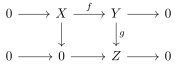
就给出同伦范畴 $K(R-\mathrm{Mod})$ 中的拟同构, 但它不是同伦等价.
投射分解总是存在的, 但不唯一. 借助同伦关系, 在同伦等价的意义下唯一. 设 $\ca$ 是有足够多投射对象的 Abel 范畴.

即 $f \pi=\pi^{\prime} \alpha_0$. 进一步, 如果还有链映射 $\beta: P \longrightarrow Q$ 使得上图也交换(即 $\left.f \pi=\pi^{\prime} \beta_0\right)$, 则 $\alpha$ 与 $\beta$ 同伦.
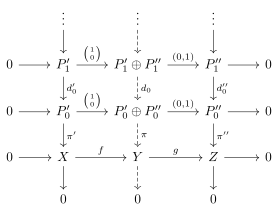
从而有复形的链可裂短正合列 $0 \longrightarrow P^{\prime} \longrightarrow P \longrightarrow P^{\prime \prime} \longrightarrow 0$ 使得 $P \longrightarrow Y \longrightarrow 0$是 $Y$ 的一个投射分解.
设 $F:\ca\to\cb$ 是 Abel 范畴之间的左正合加法函子, $0\to A\to B\to C\to0$ 是 $\ca$ 中的短正合列. 作用 $F$ 得到正合列 $$0\rightarrow F(A)\rightarrow F(B)\rightarrow F(C) .$$ 我们会问能否向右延长这个正合列得到长正合列. 严格来说这个问题不是良定的, 因为有很多种不同的延长方法. 但是当 $A$ 的性质足够好时, 存在一种由右导出函子给出的典范方法. 对任意 $i\ges1$, 存在函子 $\mr{R}^iF:\ca\to\cb$ 使得一下为正合列 \begin{array} 00\!\!\!\! &\to F(A)\!\!\!\! &\to F(B)\!\!\!\! &\to F(C)\\ &\to \mr{R}^1F(A)\!\!\!\! &\to \mr{R}^1F(B)\!\!\!\! &\to \mr{R}^1F(C)\\ &\to \mr{R}^2F(A)\!\!\!\! &\to \mr{R}^2F(B)\!\!\!\! &\to \mr{R}^2F(C)\!\!\!\!\!\!\!\! &\to\cdots \end{array} 由此可得 $F$ 为正合函子当仅当 $\mr{R}^1F=0$. 在这个角度下, $F$ 的右导出函子衡量了 $F$ 成为正合函子的障碍. 如果 $0\to A\to B\to C\to0$ 中的 $A$ 是内射对象, 则为可列短正合列, 加法函子保持可列短正合列. 特别地, $\mr{R}^1F(A)=0$. 内射对象上的右导出函子为 $0$, 这是如下构造的动机.
6.2. Construction and first properties
需要对 Abel 范畴 $\ca$ 作的关键假设为 $\ca$ 有足够多的内射对象. 即, 对任意 $\ca$ 中对象 $A$ 存在单态射 $A\to I$, 其中 $I$ 为 $A$ 中的内射对象. 下面我们来定义共变左正合函子 $F:\ca\to\cb$ 的右导出函子. 任取 $X\in\ca$, 考虑其内射分解 $$0\to X\to I^0\to I^1\to I^2\to\cdots,$$ 将 $F$ 作用到 $X$ 的删项内射分解上得到链复形 $$0\to F(I^0)\to F(I^1)\to F(I^2)\to\cdots.$$ 注意:此链复形一般不再是正合列. 但我们可以计算第 $i$ 处的上同调(从 $F(I^i)$ 出发的核模掉到 $F(I^i)$ 的像), 记为 $\mr{R}^iF(X)$. 现在还有很多事情需要核对:
- $\mr{R}^iF(X)$ 不依赖于 $X$ 的内射分解.
- 任何态射 $X\to Y$ 可以自然地产生态射 $\mr{R}^iF(X)\to \mr{R}^iF(Y)$.
6.3. Variations 如果我们从共变右正合函子 $G$ 出发, 并且假设范畴 $\ca$ 有足够多的投射对象, 那么可以类似地定义左导出函子. 任取 $X\in \ca$, 取其投射分解 $$\cdots\to P_2\to P_1\to P_0\to X\to0$$ 将 $G$ 作用于删项投射分解得 $$\cdots\to G(P_2)\to G(P_1)\to G(P_0)\to0.$$ 计算上同调(homology)得到 $\mr{L}_iG(X)$. 和之前类似, $\mr{L}_0G(X)=G(X)$. \begin{array}{rcccccc} \cdots & \to & \mr{L}_2 G(A) & \to & \mr{L}_2 G(B) & \to & \mr{L}_2 G(C)& \\ & \to & \mr{L}_1 G(A) & \to & \mr{L}_1 G(B) & \to & \mr{L}_1 G(C)& \\ & \to & G(A) & \to & G(B) & \to & G(C) & \to0 \end{array} 左导出函子在投射对象上为零. 从反变左正合函子 $F$ 出发, 相应得右导出函子也是反变的. 短正合列 $0\to A\to B\to C\to0$ 随之变成长正合列 \begin{array} 00\!\!\!\! &\to F(C)\!\!\!\! &\to F(B)\!\!\!\! &\to F(A)& \\ &\to \mr{R}^1F(C)\!\!\!\! &\to \mr{R}^1F(B)\!\!\!\! &\to \mr{R}^1F(A)& \\ &\to \mr{R}^2F(C)\!\!\!\! &\to \mr{R}^2F(B)\!\!\!\! &\to \mr{R}^2F(A)\!\!\!\!\!\!\!\! &\to\cdots \end{array} 这些左导出函子在投射对象上都为零, 因此可以通过投射分解计算.
7. $\mr{Ext}^n$ 函子 7.1. 背景 为了帮助理解 $\Ext$ 的含义, 我们现在研究模的扩张问题.
由于短正合列的同构是一个等价关系, 我们把 $M$ 通过 $N$ 扩张的同构类记为 $E(M,N)$. 我们将建立集合 $E(M,N)$ 与 $\Ext^1_R(M,N)$ 之间的对应关系, 然后证明这个映射是集合的等价, 从而提示了 $\Ext$ 来源于 Extension.
设有 $M$ 通过 $N$ 的扩张 $E$: $$0\to N\xrightarrow[]{\alpha} E\xrightarrow[]{\beta} M\to 0,$$ 用函子 $\mr{Hom}(-,N)$ 作用后得长正合列 $$ \begin{aligned} 0 & \rightarrow \operatorname{Hom}(M, N) \xrightarrow{\bar{\beta}} \operatorname{Hom}(E, N) \xrightarrow{\bar{\alpha}} \operatorname{Hom}(N, N) \\ & \xrightarrow{\Delta^0} \operatorname{Ext}^1(M, N) \rightarrow \operatorname{Ext}^1(E, N) \rightarrow \operatorname{Ext}^1(N, N)\cdots \end{aligned} $$ 根据 $\Ext$ 函子得性质(4), 两个同构的扩张诱导了相同的连接态射 $\delta_E:=\Delta^0$. 因此对于扩张的同构类 $[E]\in E(M,N)$, 可以定义 $$\mr{ch}(E)=\delta_E(1_N)\in\Ext^1_R(M,N),$$ 称为 $[E]$ 的示性类 (characteristic class).
- $\operatorname{Ext}_{\mathcal{A}}^0(-, N) \cong \operatorname{Hom}_{\mathcal{A}}(-, N)$.
- 若 $M$ 是投射对象, 则 $\operatorname{Ext}_{\mathcal{A}}^n(M, N)=0, \forall n \ges 1$.
- 对于 $\mathcal{A}$ 中短正合列 $0 \longrightarrow M^{\prime} \xrightarrow{f} M \xrightarrow{g} M^{\prime \prime} \longrightarrow 0$, 有 Abel 群的长正合列 \begin{align*} 0 &\longrightarrow \operatorname{Hom}\left(M^{\prime \prime}, N\right) \xrightarrow{(g, N)} \operatorname{Hom}(M, N) \xrightarrow{(f, N)} \operatorname{Hom}\left(M^{\prime}, N\right)\\ & \xrightarrow{c^0} \operatorname{Ext}_{\mathcal{A}}^1\left(M^{\prime \prime}, N\right)\rightarrow \operatorname{Ext}_{\mathcal{A}}^1\left(M , N\right)\rightarrow \operatorname{Ext}_{\mathcal{A}}^1\left(M^{ \prime}, N\right)\to\cdots \end{align*}
- 连接同态 $c^n: \operatorname{Ext}_{\mathcal{A}}^n\left(M^{\prime}, N\right) \longrightarrow \operatorname{Ext}_{\mathcal{A}}^{n+1}\left(M^{\prime \prime}, N\right)$ 是自然的, $\forall n \ges 0$.
7.2.2. 左正合共变函子设 $\ca$ 是有足够多内射对象的 Abel 范畴. 考虑左正合函子 $\Hom{\ca}{M,-}:\ca\to\mr{Ab}$ 的第 $n$ 次右导出函子 $\mr{ext}^n_\ca(M,-):\ca\to\mr{Ab}$. 对于 $\ca$ 中对象 $N$, 记 $$\mr{ext}^n_\ca(M,-)(N)=:\mr{ext}^n_\ca(M,N).$$ 取 $N$ 的一个内射分解 $$ 0 \longrightarrow N \xrightarrow{\varepsilon} I^0 \xrightarrow{d^0} I^1 \xrightarrow{d^1} I^2 \longrightarrow \cdots. $$ 得到复形 $\operatorname{Hom}_{\mathcal{A}}(M, I):=\operatorname{Hom}_{\mathcal{A}}(M,-)(I)$ : $$ 0 \longrightarrow \operatorname{Hom}_{\mathcal{A}}\left(M, I^0\right) \xrightarrow{\left(M, d^0\right)} \operatorname{Hom}_{\mathcal{A}}\left(M, I^1\right) \xrightarrow{\left(M, d^1\right)} \operatorname{Hom}_{\mathcal{A}}\left(M, I^2\right) \longrightarrow \cdots $$ 由定义即知 $$ \begin{aligned} &\operatorname{ext}_{\mathcal{A}}^n(M, N) =\mathrm{H}^n \operatorname{Hom}_{\mathcal{A}}(M, I) \\ =&\operatorname{Ker} {\operatorname{Hom}_{\mathcal{A}}}\left(M, d^n\right) / \operatorname{Im} {\operatorname{Hom}_{\mathcal{A}}}\left(M, d^{n-1}\right), \quad \forall n \ges 0 \end{aligned} $$
- $\operatorname{ext}_{\mathcal{A}}^0(M,-) \cong \operatorname{Hom}_{\mathcal{A}}(M,-)$.
- 若 $N$ 是内射对象, 则 $\operatorname{ext}_{\mathcal{A}}^n(M, N)=0, \forall n \ges 1$.
- 设 $0 \longrightarrow N^{\prime} \xrightarrow{f} N \xrightarrow{g} N^{\prime \prime} \longrightarrow 0$ 是 $\mathcal{A}$ 中正合列. 则有 Abel 群的长正合列 \begin{align*} 0 &\longrightarrow \operatorname{Hom}\left(M, N^{\prime}\right) \xrightarrow{(M, f)} \operatorname{Hom}(M, N) \xrightarrow{(M, g)} \operatorname{Hom}\left(M, N^{\prime \prime}\right)\\ &\xrightarrow{c^0} \operatorname{ext}_{\mathcal{A}}^1\left(M, N^{\prime}\right)\to \operatorname{ext}_{\mathcal{A}}^1\left(M, N \right)\to \operatorname{ext}_{\mathcal{A}}^1\left(M, N^{\prime\prime}\right)\to \cdots \end{align*}
- 连接同态 $c^n: \operatorname{ext}_{\mathcal{A}}^n\left(M, N^{\prime \prime}\right) \longrightarrow \operatorname{ext}_{\mathcal{A}}^{n+1}\left(M, N^{\prime}\right)$ 是自然的.
设 $\ca$ 是 Abel 范畴, 并且 $\ca$ 既有足够多的投射对象, 又有足够多的内射对象. 例如, 环 $R$ 的左模范畴 $\mr{R-mod}$ 和右模范畴 $\mr{mod\,R}$, Artin 代数 $A$ 的有限生成左模范畴 $A-\mr{mod}$ 和有限生成右模范畴 $\mr{mod}\,A$. 自然的问题是, 对于 $\ca$ 中任意对象 $M$ 和 $N$, 以及任意 $n\ges0$, 是否有 Abel 群的同构 $$\Ext_\ca^n(M,N)\cong \mr{ext}_\ca^n(M,N).$$
- 如果 $\mathcal{A}$ 有足够多投射对象, 则下述等价:
- $I$ 是内射对象;
- $\operatorname{Ext}_{\mathcal{A}}^n(M, I)=0, \forall M \in \mathcal{A}, \forall n \ges 1$;
- $\operatorname{Ext}_{\mathcal{A}}^1(M, I)=0, \forall M \in \mathcal{A}$.
- 如果 $\mathcal{A}$ 有足够多投射对象, 则下述等价:
- $P$ 是投射对象;
- $\operatorname{Ext}_{\mathcal{A}}^n(P, N)=0, \forall N \in \mathcal{A}, \forall n \ges 1 $;
- $\operatorname{Ext}_{\mathcal{A}}^1(P, N)=0, \forall N \in \mathcal{A}$.
- 如果 $\mathcal{A}$ 有足够多内射对象, 则下述等价:
- $I$ 是内射对象;
- $\operatorname{ext}_{\mathcal{A}}^n(M, I)=0, \forall M \in \mathcal{A}, \forall n \ges 1$;
- $\operatorname{ext}_{\mathcal{A}}^1(M, I)=0, \forall M \in \mathcal{A}$.
- 如果 $\mathcal{A}$ 有足够多内射对象, 则下述等价:
- $P$ 是投射对象;
- $\operatorname{ext}_{\mathcal{A}}^n(P, N)=0, \forall N \in \mathcal{A}, \forall n \ges 1$;
- $\operatorname{ext}_{\mathcal{A}}^1(P, N)=0, \forall N \in \mathcal{A}$.
证明
取 $M$ 的一个投射分解: $$\cdots \longrightarrow{ }_A A \xrightarrow{d_1}{ }_A A \xrightarrow{d_0}{ }_A A \xrightarrow{\pi} M \longrightarrow 0,$$ 其中 $$ \begin{aligned} \pi:& A \longrightarrow M, \quad f(x)+\left\langle x^s\right\rangle \longmapsto f(x)+\left\langle x^r\right\rangle, \\ d_{2 t}=x^r:& A \longrightarrow A, \quad f(x)+\left\langle x^s\right\rangle \longmapsto x^r f(x)+\left\langle x^s\right\rangle, \quad \forall t \ges 0 \\ d_{2 t-1}=x^{s-r}:& A \longrightarrow A, \quad f(x)+\left\langle x^s\right\rangle \longmapsto x^{s-r} f(x)+\left\langle x^s\right\rangle, \quad \forall t \ges 1 . \end{aligned} $$ 将函子 $\operatorname{Hom}_A(-, M)$ 作用在 $M$ 的删项投射分解上, 得到复形的交换图, 其中坚直的同态均为同构

因此 $$ \begin{align*} \operatorname{Ext}_A^0(M, M) &\cong \operatorname{Hom}_A(M, M) \cong \operatorname{Ker} \operatorname{Hom}_A\left(x^r, M\right)=\operatorname{Ker} 0 \cong M \\ \operatorname{Ext}_A^{2 n-1}(M, M) &\cong \operatorname{Ker}\Big(M \xrightarrow{x^{s-r}} M\Big) \cong \begin{cases}M, & s \ges 2 r \\ \frac{\left\langle x^{2 r-s}\right\rangle}{\left\langle x^r\right\rangle}, & s<2 r\end{cases} \\ \operatorname{Ext}_A^{2 n}(M, M)&=\frac{M}{\operatorname{Im}\Big(M \xrightarrow{x^{s-r}} M\Big)} \cong \begin{cases}M \\ \frac{k[x]}{\left\langle x^{s-r}\right\rangle} \cong \frac{\left\langle x^{2 r-s}\right\rangle}{\left\langle x^r\right\rangle}, & s<2 r\end{cases} \end{align*} $$ 综上所述我们有 $$ \operatorname{Hom}_A(M, M) \cong M, \quad \operatorname{Ext}_A^n(M, M) \cong\left\{\begin{array}{ll} M, & s \ges 2 r \\ \frac{\left\langle x^{2 r-s}\right\rangle}{\left\langle x^r\right\rangle}, & s<2 r \end{array} \quad \forall n \ges 1\right. $$
证明
取 $\mathbb{Z}_m$ 的一个投射分解: $0 \longrightarrow \mathbb{Z} \xrightarrow{m} \mathbb{Z} \longrightarrow$ $\mathbb{Z}_m \longrightarrow 0$, 得到复形的交换图, 其中坚直的同态均为同构
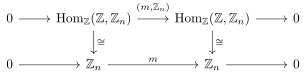
因此 $$ \begin{aligned} & \operatorname{Ext}_{\mathbb{Z}}^i\left(\mathbb{Z}_m, \mathbb{Z}_n\right)=0, \quad i \ges 2 \\ & \operatorname{Ext}_{\mathbb{Z}}^0\left(\mathbb{Z}_m, \mathbb{Z}_n\right) \cong \operatorname{Hom}_{\mathbb{Z}}\left(\mathbb{Z}_m, \mathbb{Z}_n\right) \cong \operatorname{Ker}\Big(\mathbb{Z}_n \xrightarrow{m} \mathbb{Z}_n\Big)=\frac{n}{(m, n)} \mathbb{Z} / n \mathbb{Z} \cong \mathbb{Z}_{(m, n)} \\ & \operatorname{Ext}_{\mathbb{Z}}^1\left(\mathbb{Z}_m, \mathbb{Z}_n\right) \cong \frac{\mathbb{Z}_n}{m \mathbb{Z}_n}=\frac{\mathbb{Z} / n \mathbb{Z}}{(n \mathbb{Z}+m \mathbb{Z}) / n \mathbb{Z}}=\frac{\mathbb{Z} / n \mathbb{Z}}{(n, m) \mathbb{Z} / n \mathbb{Z}}=\mathbb{Z}_{(m, n)} \end{aligned} $$ 其中 $(n, m)$ 表示正整数 $n$ 和 $m$ 的最大公约数.
- 称 $M$ 的投射维数不超过 $d$, 记作 $\operatorname{proj}.\operatorname{dim}(M) \les d$, 如果存在 $M$ 的投射分解 $$ 0 \longrightarrow P_d \longrightarrow \cdots \longrightarrow P_0 \longrightarrow M \longrightarrow 0 $$
- 称 $M$ 的投射维数是 $d$, 记作 $\operatorname{proj} . \operatorname{dim}(M)=d$, 如果 $\operatorname{proj}.\operatorname{dim}(M) \les d$, 并且不存在 $M$ 的投射分解 $0 \longrightarrow P_{d-1} \longrightarrow \cdots \longrightarrow P_0 \longrightarrow M \longrightarrow 0$.
- 若 $M$ 没有有限长的投射分解, 则称 $M$ 的投射维数为无穷, 记作 $\operatorname{proj} .\operatorname{dim}(M)=\infty$.
- $\operatorname{proj} .\operatorname{dim}(M) \les d$;
- $\operatorname{Ext}_{\mathcal{A}}^n(M, N)=0, \ff N\in\mr{Ob}(\ca)\ \forall n \ges d+1$ ;
- $\operatorname{Ext}_{\mathcal{A}}^{d+1}(M, N)=0, \ff N\in\mr{Ob}(\ca)$;
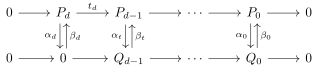
- 若 $0 \longrightarrow P_d \xrightarrow{t_d} P_{d-1} \longrightarrow \cdots \longrightarrow P_1 \xrightarrow{t_1} P_0 \xrightarrow{t_0} M \longrightarrow 0$ 是 $\mathcal{A}$ 中正合列, 且 $P_0, \cdots, P_{d-1}$ 均为投射对象, 则 $P_d$ 也是投射对象.
证明
- $\operatorname{proj} .\operatorname{dim}(M) = d$;
- $\operatorname{Ext}_{\mathcal{A}}^n(M, N)=0, \ff N\in\mr{Ob}(\ca)\forall n \ges d+1$ 且存在 $N'$ 使得 $\Ext_\ca^d(M,N')\ne0$ ;
- $\operatorname{Ext}_{\mathcal{A}}^{d+1}(M, N)=0,\ \ff N\in\mr{Ob}(\ca)$ 且存在 $N'$ 使得 $\Ext_\ca^d(M,N')\ne0$ ;
- 若 $0 \longrightarrow P_d \xrightarrow{t_d} P_{d-1} \longrightarrow \cdots \longrightarrow P_1 \xrightarrow{t_1} P_0 \xrightarrow{t_0} M \longrightarrow 0$ 是 $\mathcal{A}$ 中正合列, 且 $P_0, \cdots, P_{d-1}$ 均为投射对象, 则 $P_d$ 也是投射对象且 $t_d$ 非可裂单.
证明